Thursday, February 19, 2009

Inkheart- Cornelia Funke


Today's extra special guest blogger is a returning hero, Melody Howder. She is tackling on of the epic fantasy cycles that seemed to spring up in the wake of Harry Potter' success. In my humble opinion, it's better then most, but let's see what she has to say...

Inkheart is about a girl named Meggie who lives with her father Mo. Mo has a special power that can read characters in and out of books when he reads out loud. If he reads something out of the book something from his world has to go into the book. When Meggie was young, Mo read the book Inkheart (the title of the book with in the book) to find himself reading is wife into book while taking out of the books two bad guys named Basta and Capricorn. After ten years pass, a good guy (sometimes bad) that also came out of the book named Dustfinger comes to warn them about all the bad things Basta, Capricorn, and the rest of their crew have done. Meggie and Mo then go on an adventure to put Dustfinger back into Inkheart and to restore everything to normal. Inkheart is a beautiful piece of magic for any age. It tells you how powerful magic, books, and words can be. Warning: this book is very thick and very detailed. If you don’t like long and detailed books, then this is not ideal. Inkheart has two sequels: Inkspell and Inkdeath. Inkheart will be major motion picture on January 23, 2009.

Cornelia Funke's Site

Saturday, February 14, 2009

But Did You Read It First?- Coraline

Today I'm excited to introduce a new feature to Anbaric Lights. I know that the tagline is a book review for (and occasionally by) kids, but we're looking to spread a wings a bit here. But Did You Read It First? is going to address movie adaptations of popular children's books.

Literary adaptations are such tricky things, as we all have our own preconceived notions about the characters looks, accents, wardrobe etc... and rarely do they conform to what eventually makes it to the screen. However, if we see the the movie first, we can't help but picture the actors in our heads as we read. I'm a huge fan of personal and unique interpretations of stories, so I advocate (some would argue to the point of militancy) that reading precede viewing in every literary adaptation.

Like the publishing industry, the fantastic success of the Harry Potter films lead to an inordinate amount of adaptation rights purchased and rushed into production. Visions of enormous paydays and franchise potential lead to disappointing versions of Eragon, Series of Unfortunate Events, The Golden Compass, City of Ember, Bridge to Terebithia, City of Ember, Inkheart (perhaps soon to be tackled by our own Melody Houser soon, assuming her Inkheart book review ever gets finished) and many others soon followed.

I personally lost my taste for the movies after a so-so and defanged film version of The Golden Compass. However, I did have high hopes for Coraline, and thus it is the subject of this inaugural post.

It's no secret that I'm a huge fan of Neil Gaiman, and when I heard that he was adapting his delightfully creepy fairytale Coraline with stop motion animation genius Henry Selick of Nightmare Before Christmas and James and the Giant Peach fame my appetite was considerably whetted.

First and foremost, the story: Coraline Jones moves with her family to the Pink Paradise Apartment complex (a converted Victorian mansion) presumably so her garden catalog author/editor parents can get some work done. Coraline has left her friends behind, and is clearly unhappy in her new environment. While wondering in the hills behind her new home she encounters Wybegone, who goes by Wybie, someone who seems very wanting in regard to the friends she's left behind.

The Pink Paradise is also inhabited by Mr. Bobinsky, a washed-up Russian acrobat who is training a mouse circus, and Ms. Forcible and Ms. Spink, two decidedly over the hill former stage actresses who spend their days with their with wads of taffy and innumerable schnauzers. As Coraline mopes about (everyone calls her Caroline) her parents are too consumed with their work to pay her any mind. They won't even let her play outside in the rain for fear of tracking mud into the house. Gardening author/editors indeed. Her father, in a fit of absent-minded, ill-advised and work-obsessed parenting skills gives Coraline a notebook and tells her to count all of the doors and windows in the house.

It is during one such accounting task that she finds a mysterious and tiny door hidden behind the wallpaper of their living room. Her mother, just to shut Coraline up, produces the key and opens it. The open the door only to find it bricked over. However, later that night Coraline returns to the door and finds a mysterious tunnel waiting for her. Upon traversing it she encounters a world very similar to her own.

Her parents are there but different. One, they have buttons for eyes, and two everything is better. The food is delicious, her parents are loving and attentive, her father has grown the garden to resemble her face, and the neighbors are considerably sprier and more entertaining than they were back in Coraline's world. No one calls her "Caroline," but did I mention that everyone has "BUTTONS FOR EYES!!!?"

At first everything is wonderful, but when the buttons, needle and thread are pulled out for Coraline herself, she realizes that things were better at her (real) home. What follows is her struggle to return home and defeat the evil and frankly terrifying machinations of her "other Mother."

Now, the look. Selnick has truly outdone himself with this one. The look of the whole film is gorgeous, but the other world is especially breathtaking. Bobinsky's mouse circus, the stage show performed by Forcible and Spink, the Garden, the horribly elongated and arachnid true form of the other mother, all rendered in gorgeous stop-motion animation and 3-D (be prepared to pay a little extra for the privilege).

Does it do the book justice? Most definitely. Fans of the book and neophytes alike will delight in Selnick's achievement in Coraline. To my devoted audience of readers (all almost several of you) I put forth the following request: let's look at forthcoming or recently released children's literature adaptations. Who wants to be the first guest blogger for But Did You Read It First?? Inkheart is still in theaters, and City of Ember just came out on DVD. Let me know what you are thinking, and there might be a trip to the movies on my dime in it for you...

Monday, February 9, 2009

Esperanza Rising- Pam Muñoz Ryan

Today's guest blog comes to us courtesy of a first time extra special guest blogger, Miss Frisby. She's been a dedicated commenter for a while (always very much appreciated Miss Frisby) and now get ready for her anbariclights debut. On a related note, if you leave the origin of her nom de plume in the comments section, you can see me for a special prize. (Sorry Miss Frisby, you're excluded from this offer.)
Sir Readsalot

Esperanza Rising, by Pam Muñoz Ryan, is a really great book. Esperanza Ortega lived a life full of ups, never downs, and servants. First, she doesn’t care about any thing or anyone around her. Then, she changes into a different person.
One day, in the springtime just before her 13th birthday, her Papi never comes home. Earlier in the day, her Mama had warned him about bandits. When he finally comes home lying in a cart pulled by workers, he is dead. Then later in the spring, Esparanza is asleep and she just makes it out alive when a fire rages through her house. The house burns down, and Esperanza’s Abuela, or grandma, hurts her foot. Her mean uncles come for the property and her family moves to America. There, Esperanza must do something she’s never done before, work on a farm picking vegetables.

What else will happen to her? Read the book to find out. This book is for people who like Mexican history and adventure. Esperanza changes by the end of the book.


Wednesday, January 28, 2009

Congratulations Neil Gaiman!

Wow, I never thought I'd see the day, but one of my all-time favorite authors, Neil Gaiman, a man that I regard as visionary, but not particularly mainstream, has been honored with the Newberry award for his recently published The Graveyard Book, reviewed here. It's always a pleasure to see some of my favorite authors make good. Congratulations Neil. I can't wait to see Coraline. a full list of award winners for 2009: (from the ALA website. Check the links on the homepage.)

2009 Medal Winner

The 2009 Newbery Medal winner is The Graveyard Book by Neil Gaiman, illustrated by Dave McKean, and published by HarperCollins Children's Books.

A delicious mix of murder, fantasy, humor and human longing, the tale of Nobody Owens is told in magical, haunting prose. A child marked for death by an ancient league of assassins escapes into an abandoned graveyard, where he is reared and protected by its spirit denizens.

"A child named Nobody, an assassin, a graveyard and the dead are the perfect combination in this deliciously creepy tale, which is sometimes humorous, sometimes haunting and sometimes surprising," said Newbery Committee Chair Rose V. Treviño.


2009 Honor Books

The Underneath by Kathi Appelt, illustrated by David Small (Atheneum Books for Young Readers, an imprint of Simon & Schuster Children's Publishing)

Underneath the canopy of the loblolly pines, amid the pulsating sounds of the swamp, there lies a tale. Intertwining stories of an embittered man, a loyal hound, an abandoned cat and a vengeful lamia sing of love, loss, loneliness and hope. Appelt's lyrical storytelling heightens the distinguished characteristics of this work.


The Surrender Tree: Poems of Cuba's Struggle for Freedom by Margarita Engle (Henry Holt & Comapny)

The Surrender Tree utilizes compelling free verse in alternating voices to lyrically tell the story of Cuba's three wars for independence from Spain. Combining real-life characters (such as legendary healer Rosa La Bayamesa) with imagined individuals, Engle focuses on Rosa's struggle to save everyone--black, white, Cuban, Spanish, friend or enemy.

Savvy by Ingrid Law (Dial Books for Young Readers, a division of Penguin Young Readers Group in partnership with Walden Media, LLC

This rich first-person narrative draws readers into a wild bus ride, winding through the countryside on a journey of self-discovery for Mibs Beaumont and her companions. Newcomer Law weaves a magical tall tale, using vivid language and lively personalities, all bouncing their way to a warm, satisfying conclusion.

After Tupac & D Foster by Jacqueline Woodson (G.P. Putnam's Sons, a division of Penguin Books for Young Readers)

This tightly woven novel looks back on two years in a New York City neighborhood, where life changes for two 11-year-olds when a new girl joins their game of double Dutch. Bonded by Tupac's music, the three girls explore the lure of freedom and build a friendship that redefines their own identities.

Sunday, January 25, 2009

The Sisters Grimm- Michael Buckley


The Sisters Grimm, by Michael Buckley, is a relatively pleasant addition to the genre sometimes known as "fractured fairytales," i.e. conventional themes and characters from world folklore updated and adapted for new settings, contemporary environments, or additional adventures.

In this case we have the sisters of the title, Sabrina and Daphne, who are the great great grandchildren of the legendary Jacob and Wilhelm Grimm. In the story, the Brothers Grimm were not just compilers of the stories they grew up recording, but recorders of actual events in Europe and the rest of the world.

Once contact between the characters of the stories (Prince Charming, the three little pigs, Jack-he of "and the beanstalk" fame-, the Queen of Hearts, Beauty and the Beast, Shere Khan from The Jungle Book, Mama Bear, Puck, among many, many others...) became too frequent, they moved to the then unsettled by Europeans continent of North America. There, a spell was cast by the legendary witch Baba Yaga confining all of these magical beings (referred to as "Everafters") to a small town in upstate New York. The descendants of the Grimms also live in the town and serve as the town's detective and overseers. The spell keeps the Everafters trapped in the town as long as there is a Grimm living there. Needless to say, the Grimms are not very popular with the denizens of the town...

As the story begins, Daphne and Sabrina are unaware of their heritage and destinies. Their Father, Henry, had turned his back on the family business and raised them oblivious in New York City. Unfortunately, Henry and the girls' mother, Veronica, have disappeared at the beginning of the story.

The girls have been bounced around from one foster home to another for the better part of a year. Eventually, they end up on the way to live with a grandmother they never knew they had in the town of Ferryport (originally "Fairy"port...get it?) New York.

Their grandmother, Relda Grimm, greets them enthusiastically with her companion Mr. Canis and an enormous great dane named Elvis. He's a major "Everafter" but I'll let you find out who for yourself. His name is a big hint, however. Sabrina, the older of the two sisters, is very wary and suspicious (especially after a year of awful foster home experiences) and is keen to escape from the house as soon as possible. The younger Daphne is more loving and trusting and is quick to believe Relda's story about being their grandmother.

After an escape attempt is foiled by an attack of malevolent pixies, the girls are forced to accept that there may be more to Ferryport than initially meets the eye. Just as they start to learn about their role as Grimms they run afoul of an angry giant and a mysterious plot that may or may not lead back to Ferryport's mayor, the nefarious Prince Charming.

Relda and Canis are kidnapped, and the rest of the story follows the attempts of Daphne and Sabrina (along with the aid of Puck, a magic mirror, and Jack of FEE-FI-FO-FUM fame who has particular expertise regarding giants) to save their new family and friends from the giant, avoid the attention of three porcine policemen, and figure out just what exactly it is that Charming is up to.
along the way we see Ichabod Crane, Dorothy's Ruby Slippers, Ali Baba's flying carpet, and even Excalibur! Buckley has a lot of fun with these beloved and familiar characters, and he balances the story well with tantalizing hints about a larger conspiracy involving the disappearance of Daphne and Sabrina's parents. Presumably, this larger mystery will be examined and solved over the course of the five subsequent sequels. I have heard that the sequels get pretty repetitive over time, the same fate that I felt befell the latter Series of Unfortunate Events books which became the same story over and over and over. It remains to be seen whether or not Buckley can keep his relatively original idea fresh. I'd love feedback from any readers who are familiar with any of the sequels; leave your thoughts in the comments section.

Sisters Grimm Site

Saturday, December 27, 2008

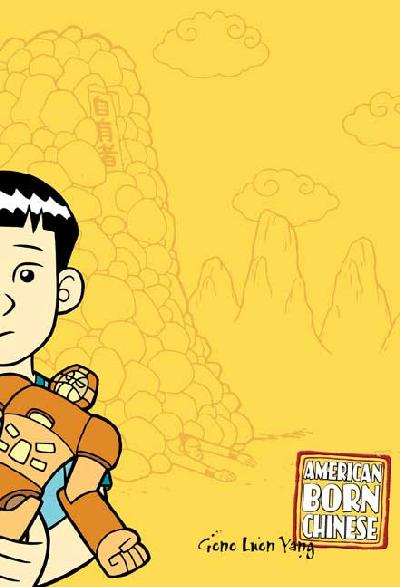
American Born Chinese- Gene Luen Yang

Too many people view graphic novels as a genre, rather than a format. Too often, they are associated with super heroes, or more recently, Japanese manga characters. Only recently have we seen the medium start to receive the critical respect it so richly deserves.

American Born Chinese, by Gene Luen Yang, is one such example of an illuminating and often heart-breaking story told in a manner once described by Will Eisner as "sequential art."

ABC begins as three separate parallel narratives that eventually intertwine themselves into one cohesive strand by the stories end. One is relatively realistic, the other is very fantastical, and the third is satirical, often gut-wrenchingly so.

The main story describes the life of Jin Wang, the "American Born Chinese" boy of the title. He lives in Sn Francisco, and despite the fact that he was born there, is treated as foreign and different by his classmates. When another student from Taiwan, Wei-Chen Sun, joins his fourth grade class he initially does not want to be associated with someone so "FOB" (Fresh Off the Boat). However, they bond over their mutual love of transforming robots and end up becoming best friends with each other. Their friendship grows throughout the story which follows the boys from elementary to high schools.

Jin really wants to fit in with his other classmates, while Wei-Chen remains a tie to his Chinese heritage. This remains a powerful theme throughout ABC: How can an individual exist in between such separate and distinct worlds? Is it possible to exist in one world while at the same time remaining true to or honoring another?

Over time, Jin comes to resent his Chinese heritage, until he remembers the words an old shopkeeper told him when he was a boy, "It is easy to become anything you wish, so long as you are willing to forfeit your soul." In this case what Jin wants is to be American, which in this book means Caucasian, white. Jin has never been treated as an American despite the fact that his citizenship is just as valid as that of his classmates.

Yang has wonderful and thought-provoking things to say about what it means to truly be "American" in the 21st century. It is sometimes very easy to forget that barring American Indians, America is a nation of immigrants, and it is our diversity and our core values of acceptance and tolerance that make us such a great nation. We don't often see these American ideals trumpeted in this day and age of jingoistic, and xenophobic "patriotic" fervor.

The second narrative tells the story of the Monkey King, ruler of the Flower Fruit Mountain, and master of all 12 disciplines of Kung Fu (including the particularly awesome "Hair into Clones" where one can turn strands of hair into clones of oneself). When he is denied entrance to a dinner party in Heaven because he is a monkey, he sets about changing his ways. He begins to wear shoes, he changes his size, and forces his subjects to do the same. In other words, her rejects his heritage in order to try and gain acceptance from another group. Sound familiar? Good, I don't think the parallels between the Monkey King's story and Jin's are a coincidence.

The final narrative takes the form of a television sitcom complete with laughter and applause tracks. It tells the story of Danny, an All-American boy who must deal with the social horrors of the frequent visits by his cousin Chin-Kee. Chin-Kee is a horrifying amalgamation of just about every negative Chinese stereotype you can think of: he has slanted eyes, buck teeth, he switches his "r" and "l" sounds, he eats cats and dogs, he wears a coolie hat, and, unsurprisingly, he is a master of Kung Fu. However, he is enthusiastic and kind, only wanting to have fun with his cousin and experience American society. Danny, of course, is mortified. Chin-Kee's actions guarantee that he will remain a pariah in the harsh social landscape of high school. The struggle between Danny's All-American hopes and dreams and Chin-Kee's stereotypical buffoonery mirror Jin's internal struggle in the realistic narrative. Chin-Kee serves as an example of not only how other students view Chinese culture, but how Jin himself views his culture when it is seen through the lens of American society.

I would do Yang a grave disservice to reveal how ably he weaves these stories together in the end, but I will echo the back of the book: "Three very different characters. One Simple Goal. To Fit In." American Born Chinese is a brave book that challenges the reader to acknowledge that racism exists, even in 21st century America, even in forms that you might not immediately recognize.

American Born Chinese was the first graphic novel to ever be nominated for a National Book Award, and it won the American Library Association's Printz Award for excellence in young Adult Literature.

Check out Gene Yang's website here: http://www.humblecomics.com/

I especially like the Monkey King section, who he describes as "Sun Wukong, the Monkey King, is probably the most beloved fictional character in the Eastern world. He's like the Asian Mickey Mouse, only without the squeaky voice and corporate sponsorship."

The Way We Work- David Macaulay


I've been blogging here for a while now, and although I'm making good progress, and starting to get outside contributions, I've focused almost exclusively on fiction. This review is part of my effort to rectify that situation.

When approaching informative nonfiction, there are few better places to begin than David Macaulay. He's been writing books for years, but he's probably best known for The Way Things Work, his amazingly accessible, readable, and beautifully illustrated guide to...the way things work. And by things he means anything from headphones, to a television, to the space shuttle, to a flush toilet.

Now he returns with his eagerly anticipated The Way We Work, whereupon he turns his finely attuned artist's eye, and keen sense of humor to the human body. Just like with his previous work, TWWW tackles the human body in minute and exacting detail. Ever wonder how your lungs work? How about your colon? spinal cord? memories? how the brain and eye process images? Where poop comes from? How about babies? What's DNA? How do your vocal cords work? This book answers just about every human body question you can possibly ask, including a bunch you never thought to ask, or never really wanted to know the answer to.

Throughout, Macaulay explains these processes in relatively simple English (it might not be appropriate for the total layperson, but anyone with more than a passing knowledge of human anatomy and physiology should be fine) and with breathtaking illustrations. Let's face it, no one reads a Macaulay book for the text.

The art is mesmerizing, anatomically correct, yet far from clinical and detached. Macaulay's work is full of whimsy, whether it's shouted conversations between bacteria in feces or a man pulling aside his stomach to show the viewer the true location of his pancreas. The colors are warm and vivid, and even the most complicated biological processes (Tumor growth? Nerve impulses? Any of your senses? No problem.) are clearly depicted in easy to follow diagrams and sequences.

Check out the following depiction of blood circulating through the body:


Trust me, this ride is worth the wait.

Here's how your nasal cavity works...


After reading this, I'll never feel the same way about snot again.

Check out more of the art here (click on the interior slideshow), or better yet, just buy the darn thing here.

The Way We Work is another informational triumph on Macaulay's part. You could read and reread this book everyday for the rest of your life, and you would still discover something new each time. Highly recommended.

Also, if you're local, there's an exhibition of Macaulay's work at the RISD museum. Check it out before it's gone...