Showing posts with label Award Honors/Winners. Show all posts

Sunday, March 21, 2010

When You Reach Me- Rebecca Stead

Sorry gentle reader(s). Once again, an unforgivably long period of time has passed between my reviews. Life, as they say, happens, but I now find myself with a bit of free time, and a stack of books three feet high that I'm going to try and get through. In addition to this post, look for a review of Neil Gaiman's latest coming soon as well.

I didn't get a chance to do a post on this year's American Library Association (most notably the Caldecott and Newbery Awards- for a complete list of this years winners and honorees go here.) but I wanted to make sure that this year's Newbery winner, When You Reach Me, by Rebecca Stead got its proper due in these hallowed yet electronic pages.

When You Reach Me is nothing short of an amazing and mesmerizing second novel from Rebecca Stead. She effortlessly blends at least three genres (realistic fiction, mystery, and science fiction, and throw in historical fiction to boot as the book is set in 1979.) and her characters and depiction of New York City never once seem forced or contrived.

In the story, Miranda is a regular, everyday sixth grader living in 1978-1979 New York City. Her mother is a paralegal who is training to appear on the game show The 20,000 Dollar Pyramid. Like many sixth graders, Miranda struggles with friendships, boys, money, her mother, school, bullies, and, oh yes, mysterious anonymous letters that know too much about her, and appear to be sent from the future.

It's thee letters that make When You Reach Me so great. The first reads:

I'm coming to save your friends life and my own.
I ask two favors.
First, you must write me a letter.

Miranda has no idea where the letter came from or who sent it. As more letters appear, it is clear that the author knows things about the future that no one should, and Mira becomes increasingly enmeshed in what appears to be prophecy. The juxtaposition of Mira's everyday sixth grade life and the mysteries of time travel shouldn't work at all, yet all aspects of the plot come together seamlessly and the resolution (like all truly great resolutions should) leaves the reader thinking, pondering, and mulling for days afterwards. Couple this with an extended running homage to Madeline L'Engle's A Wrinkle in Time, and you have a book truly worthy of the Newbery's lofty pedigree. Highly recommended.


Monday, June 15, 2009

The Penderwicks on Gardam Street-Jeanne Birdsall

Today's extra special guest blogger is a another returning hero, Ephos Sapphire. They have decided to focus on the sequel to Jeanne Birdsall's delightful tale of summer vacation and adventure, The Penderwicks. Read on to decide if the followup is worth your time...
-Sir Readsalot

The Penderwicks on Gardam Street is a thrilling must-have for everyone. However, you should read the first book: The Penderwicks before you start its follow-up. The plotline is about a hysterically funny family named the Penderwicks who have just gotten back from a family vacation to Arundel in the Berkshires. The four girls are Rosalind, Skye, Jane, and Batty. Rosalind, or Rosy, is a sweet 13 year old who took over for her mother. Skye is a soccer-loving tomboy who hates babies and cats. Jane is a creative writer who is fixated on her book series: Sabrina Starr. Fourth and finally comes Batty (Elizabeth) who is funny and cute. Four and 1/3 years before the book begins, right after the fourth sister, Batty, is born, their mother gets very ill. The doctors are sure she won’t live long. The day before she dies, she writes a letter to her husband. It’s about dating. She feels that he may get lonely. When giving the letter to her sister, Mother tells her to deliver it to him when she feels the time is right. When Batty is almost five, the sister, or Aunt Claire, gives the letter to the father, Martin. While eavesdropping on their father, the four girls hear about the dating. In order to discourage a potential step-mother, they plan terrible dates for their father. These only make him come home mad and muttering Latin swears. Their father seems to have a growing interest with the astrophysicist next door, Iantha. Will Skye outgrow her feelings and learn to like Iantha’s son and cat, Ben and Asimov? Will the sisters end up with a step-mother or will Martin stay single forever? Read this new, hilarious, and compelling book and you will be amazed at how wonderfully Jeanne Birsall spins her words.

Jeanne Birdsall's Website

Monday, February 9, 2009

Esperanza Rising- Pam Muñoz Ryan

Today's guest blog comes to us courtesy of a first time extra special guest blogger, Miss Frisby. She's been a dedicated commenter for a while (always very much appreciated Miss Frisby) and now get ready for her anbariclights debut. On a related note, if you leave the origin of her nom de plume in the comments section, you can see me for a special prize. (Sorry Miss Frisby, you're excluded from this offer.)
Sir Readsalot

Esperanza Rising, by Pam Muñoz Ryan, is a really great book. Esperanza Ortega lived a life full of ups, never downs, and servants. First, she doesn’t care about any thing or anyone around her. Then, she changes into a different person.
One day, in the springtime just before her 13th birthday, her Papi never comes home. Earlier in the day, her Mama had warned him about bandits. When he finally comes home lying in a cart pulled by workers, he is dead. Then later in the spring, Esparanza is asleep and she just makes it out alive when a fire rages through her house. The house burns down, and Esperanza’s Abuela, or grandma, hurts her foot. Her mean uncles come for the property and her family moves to America. There, Esperanza must do something she’s never done before, work on a farm picking vegetables.

What else will happen to her? Read the book to find out. This book is for people who like Mexican history and adventure. Esperanza changes by the end of the book.


Wednesday, January 28, 2009

Congratulations Neil Gaiman!

Wow, I never thought I'd see the day, but one of my all-time favorite authors, Neil Gaiman, a man that I regard as visionary, but not particularly mainstream, has been honored with the Newberry award for his recently published The Graveyard Book, reviewed here. It's always a pleasure to see some of my favorite authors make good. Congratulations Neil. I can't wait to see Coraline. a full list of award winners for 2009: (from the ALA website. Check the links on the homepage.)

2009 Medal Winner

The 2009 Newbery Medal winner is The Graveyard Book by Neil Gaiman, illustrated by Dave McKean, and published by HarperCollins Children's Books.

A delicious mix of murder, fantasy, humor and human longing, the tale of Nobody Owens is told in magical, haunting prose. A child marked for death by an ancient league of assassins escapes into an abandoned graveyard, where he is reared and protected by its spirit denizens.

"A child named Nobody, an assassin, a graveyard and the dead are the perfect combination in this deliciously creepy tale, which is sometimes humorous, sometimes haunting and sometimes surprising," said Newbery Committee Chair Rose V. Treviño.


2009 Honor Books

The Underneath by Kathi Appelt, illustrated by David Small (Atheneum Books for Young Readers, an imprint of Simon & Schuster Children's Publishing)

Underneath the canopy of the loblolly pines, amid the pulsating sounds of the swamp, there lies a tale. Intertwining stories of an embittered man, a loyal hound, an abandoned cat and a vengeful lamia sing of love, loss, loneliness and hope. Appelt's lyrical storytelling heightens the distinguished characteristics of this work.


The Surrender Tree: Poems of Cuba's Struggle for Freedom by Margarita Engle (Henry Holt & Comapny)

The Surrender Tree utilizes compelling free verse in alternating voices to lyrically tell the story of Cuba's three wars for independence from Spain. Combining real-life characters (such as legendary healer Rosa La Bayamesa) with imagined individuals, Engle focuses on Rosa's struggle to save everyone--black, white, Cuban, Spanish, friend or enemy.

Savvy by Ingrid Law (Dial Books for Young Readers, a division of Penguin Young Readers Group in partnership with Walden Media, LLC

This rich first-person narrative draws readers into a wild bus ride, winding through the countryside on a journey of self-discovery for Mibs Beaumont and her companions. Newcomer Law weaves a magical tall tale, using vivid language and lively personalities, all bouncing their way to a warm, satisfying conclusion.

After Tupac & D Foster by Jacqueline Woodson (G.P. Putnam's Sons, a division of Penguin Books for Young Readers)

This tightly woven novel looks back on two years in a New York City neighborhood, where life changes for two 11-year-olds when a new girl joins their game of double Dutch. Bonded by Tupac's music, the three girls explore the lure of freedom and build a friendship that redefines their own identities.

Saturday, December 27, 2008

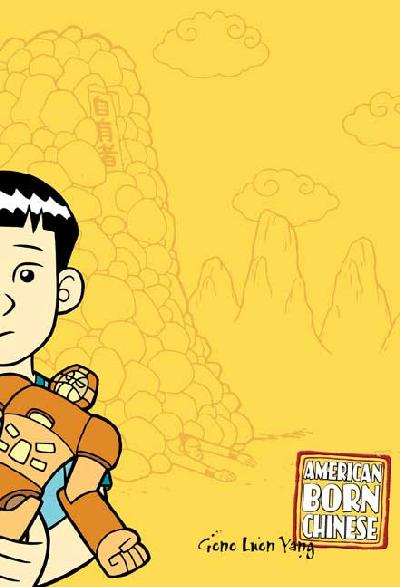
American Born Chinese- Gene Luen Yang

Too many people view graphic novels as a genre, rather than a format. Too often, they are associated with super heroes, or more recently, Japanese manga characters. Only recently have we seen the medium start to receive the critical respect it so richly deserves.

American Born Chinese, by Gene Luen Yang, is one such example of an illuminating and often heart-breaking story told in a manner once described by Will Eisner as "sequential art."

ABC begins as three separate parallel narratives that eventually intertwine themselves into one cohesive strand by the stories end. One is relatively realistic, the other is very fantastical, and the third is satirical, often gut-wrenchingly so.

The main story describes the life of Jin Wang, the "American Born Chinese" boy of the title. He lives in Sn Francisco, and despite the fact that he was born there, is treated as foreign and different by his classmates. When another student from Taiwan, Wei-Chen Sun, joins his fourth grade class he initially does not want to be associated with someone so "FOB" (Fresh Off the Boat). However, they bond over their mutual love of transforming robots and end up becoming best friends with each other. Their friendship grows throughout the story which follows the boys from elementary to high schools.

Jin really wants to fit in with his other classmates, while Wei-Chen remains a tie to his Chinese heritage. This remains a powerful theme throughout ABC: How can an individual exist in between such separate and distinct worlds? Is it possible to exist in one world while at the same time remaining true to or honoring another?

Over time, Jin comes to resent his Chinese heritage, until he remembers the words an old shopkeeper told him when he was a boy, "It is easy to become anything you wish, so long as you are willing to forfeit your soul." In this case what Jin wants is to be American, which in this book means Caucasian, white. Jin has never been treated as an American despite the fact that his citizenship is just as valid as that of his classmates.

Yang has wonderful and thought-provoking things to say about what it means to truly be "American" in the 21st century. It is sometimes very easy to forget that barring American Indians, America is a nation of immigrants, and it is our diversity and our core values of acceptance and tolerance that make us such a great nation. We don't often see these American ideals trumpeted in this day and age of jingoistic, and xenophobic "patriotic" fervor.

The second narrative tells the story of the Monkey King, ruler of the Flower Fruit Mountain, and master of all 12 disciplines of Kung Fu (including the particularly awesome "Hair into Clones" where one can turn strands of hair into clones of oneself). When he is denied entrance to a dinner party in Heaven because he is a monkey, he sets about changing his ways. He begins to wear shoes, he changes his size, and forces his subjects to do the same. In other words, her rejects his heritage in order to try and gain acceptance from another group. Sound familiar? Good, I don't think the parallels between the Monkey King's story and Jin's are a coincidence.

The final narrative takes the form of a television sitcom complete with laughter and applause tracks. It tells the story of Danny, an All-American boy who must deal with the social horrors of the frequent visits by his cousin Chin-Kee. Chin-Kee is a horrifying amalgamation of just about every negative Chinese stereotype you can think of: he has slanted eyes, buck teeth, he switches his "r" and "l" sounds, he eats cats and dogs, he wears a coolie hat, and, unsurprisingly, he is a master of Kung Fu. However, he is enthusiastic and kind, only wanting to have fun with his cousin and experience American society. Danny, of course, is mortified. Chin-Kee's actions guarantee that he will remain a pariah in the harsh social landscape of high school. The struggle between Danny's All-American hopes and dreams and Chin-Kee's stereotypical buffoonery mirror Jin's internal struggle in the realistic narrative. Chin-Kee serves as an example of not only how other students view Chinese culture, but how Jin himself views his culture when it is seen through the lens of American society.

I would do Yang a grave disservice to reveal how ably he weaves these stories together in the end, but I will echo the back of the book: "Three very different characters. One Simple Goal. To Fit In." American Born Chinese is a brave book that challenges the reader to acknowledge that racism exists, even in 21st century America, even in forms that you might not immediately recognize.

American Born Chinese was the first graphic novel to ever be nominated for a National Book Award, and it won the American Library Association's Printz Award for excellence in young Adult Literature.

Check out Gene Yang's website here: http://www.humblecomics.com/

I especially like the Monkey King section, who he describes as "Sun Wukong, the Monkey King, is probably the most beloved fictional character in the Eastern world. He's like the Asian Mickey Mouse, only without the squeaky voice and corporate sponsorship."

Monday, December 22, 2008

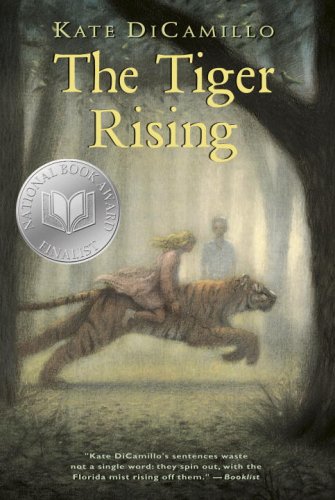
The Tiger Rising- Kate DiCamillo

Today's extra special guest blog comes courtesy of the awesomely- monikered Book Monster. Get ready for an in-depth look at a relatively unknown book from an extremely well known author...

-Sir Readsalot

I read The Tiger Rising, a Newberry Honor book, by Kate DiCamillo. In this book someone named Rob saw a tiger in a cage in the woods and Beauchamp owned him and asked Rob to feed the tiger. Then Sistene, one of Rob’s close friends talked Rob into using the keys to the tiger’s cage Beauchamp gave him to set the tiger free. I think Kate DiCamillo was good at showing Rob’s emotions. When describing Rob’s discovery she wrote, “He was so astounded at his discovery, so amazed, that he stood and stared.”
At times The Tiger Rising was hard to follow, for example when Beauchamp randomly decided to have Rob feed the tiger out of everybody and gave Rob the keys to the cage. I also think this book had interesting vocabulary, like when Kate DiCamillo wrote, “The fog was hugging the ground.” I did not like how The Tiger Rising ended with a problem. I was drawn to this book because I have read other books by Kate DiCamillo and liked them, though I do not like tigers. I recommend this book to people that like moving, as opposed to thrilling stories.

Tiger Rising was a National Book Award Finalist in 2001.

Kate Dicamillo's Website

Saturday, November 29, 2008

Escape! The Story of the Great Houdini- Sid Fleischman

As a wee lad I remember our school librarian reading Sid Fleischman's The Whipping Boy aloud to us after it won the Newberry Medal. Unfortunately, Mr. Fleischman and I parted ways shortly thereafter, and I didn't read another of his many, many books until quite recently. Shame on me.

Escape is Fleischman's biography of Harry Houdini, who, if he wasn't the greatest magician of all time, was at least the person who worked tirelessly to make sure that he was remembered as the greatest magician of all time.

Fleischman starts at the beginning, when the great Harry Houdini was still just the humble Hungarian immigrant and Rabbi's son, Erich Weiss. From there, Fleischman chronicles every step of Houdini's journey: running away from home, failed attempts at legitimate labor, traveling circuses and vaudeville shows, to finally headlining and international superstardom.

Along the way we are shown the world of professional magic, a subject that Fleischman, a former professional magician himself, writes knowledgeably and passionately about. However, Fleischman remains frustratingly true to the magician's code and refuses to divulge any of the mysteries surrounding Houdini's tricks, even though he, as he constantly reminds the reader, not only knows the secrets, but has performed them on many an occasion.

Thus, the secrets of the disappearing elephant, walking through walls, the metamorphosis trunk, and all of those wonderful death-defying escapes remain just those: secrets. Fleischman never shies away from Houdini the showman and Houdini the egomaniac. Like all great biographies, Fleischman portrays his subject warts and all. Not only does he cover Houdini as the greatest showman of his (or perhaps any other) time, but he also recounts Houdini as restless, insecure and petty, doing everything possible (airbrushing other people out of a photograph of him and Teddy Roosevelt, and embellishing the stories surrounding his greatest escapes) to destroy the reputations of his competition and ensure that the spotlight shone on him alone. Houdini even wrote a book called The Unmasking, which trashed the memory of the great French magician Robert Houdin, the man responsible for inspiring Houdini to become a magician. Houdini was such a fan that he adopted his stage name because someone mistakenly told him that an "i" at the end of a name meant like that person. Therefore, Houdin"i" means Like Houdin. As Fleischman writes, "I think this. Each field has its great icon. Einstein in science. Picasso in art. Edison in invention. There wasn't room for two icons in magic. Robert Houdin had to go."

Of course the real bread and butter (and in this case even the title) of any Houdini biography is going to be the escapes. Breaking out of everything from ropes, to handcuffs, to chains, to jails, to Siberian Prison Vans, to the belly of a sea monster (!), to locked trunks thrown into rivers, Houdini escaped from them all. Not only did he escape, but he usually escaped in minutes to the delight and amazement of his audiences. Later, once he realized how to read and work an audience, it was said that he would escape in minutes as usual, but read the paper or play solitaire for 20 minutes or so as the tension and horror in his audience built. He would challenge audience members to present manacles, chains or ropes for him to escape from, and if no one was forthcoming, he would have one of his plants in the audience "volunteer" something for him to escape from.

Later in his life, there was one thing even the great Houdini could escape from: death. He had become obsessed with debunking spiritualists and mediums, those who preyed upon the grief and sadness of others by claiming to be able to talk to the ghosts of the departed. However, despite his skepticism, Houdini always held out hope that there would be someone who could legitimately communicate with the dead. These contrary impulses probably stemmed from the death of Houdini's beloved mother.

While traveling the country exposing these charlatans as the frauds they were, Houdini also had a standing offer of a monetary reward for anyone who could conclusively communicate with the dead. Upon his own death, Houdini had an agreement with his wife. Anyone claiming to have a communication from the beyond from him would include a code phrase that only hi wife would know. Houdini passed away on Halloween 1926, and I'll leave it to you to determine if he was ever able to escape from his final challenge, death.

All in all, Fleischman does an admirable job summing up this last obsession of Houdini's: "[...] otherwise intelligent people can be duped into believing anything, no matter how absurd." I know all of my readers are intelligent, so check out Escape! in order to look into the life of one of the twentieth century's most fascinating individuals.

Thursday, November 20, 2008

Shakespeare's Secret- Elise Broach


Today's review comes courtesy of extra special guest blogger Melody Howder! She is the first in what I hope to be a long series of extra special guest bloggers.


-Sir Readsalot


Shakespeare’s Secret is about a girl named Hero who moves to Maryland and doesn’t quite fit in. One day she meets a woman who tells her that the former owner of Hero’s houses wife died and left a diamond hidden somewhere inside. Hero goes crazy because she could be famous if she finds it. As she becomes friends with the woman, she meets a boy named Danny who insists that Hero solve the mystery with him. Soon Hero finds that the former owner of her houses wife’s ancestor may be the real William Shakespeare! Is he the real Shakespeare or is it just a myth? Read this book and you’ll find out!

Shakespeare’s Secret is a story that will blow your mind! It will take you on an adventure that you never have seen before. If you are a mystery fan this is the right book for you. This is a recommended book from the Massachusetts Children’s Book Award Master List.

Saturday, August 30, 2008

Clementine- Sara Pennypacker

Clementine- by Sara Pennypacker. Pictures by Marla Frazee.

I'm a bit of a scifi/fantasy head, so on this blog I'm really making an effort to expand my genre horizons. Clementine is not necessarily a book I would have chosen to read if I were not trying to expose as many people to as diverse a range of children's literature as humanly possible.

Clementine actually appeals to me in a very nostalgic way. Some of the earliest books I remember LOVING were the works of Beverly Cleary. From the adventures of Ralph S. Mouse to Henry Huggins' puppy, to Otis Spotford finally getting his comeuppance, Cleary's works filled me with laughter and imagination, and were clearly responsible for the bibliophile I grew into. I'm sure I am not the only reviewer to make the comparison between Pennypacker's Clementine and Cleary's most enduring creation, Ramona Quimby.

Both heroines are young, irrepressible, and march to the beat of their own drummers. Both see more than their fair share (or exactly their fair share, depending on your point of view) of trouble thanks to their refusal to do things the way others want them to. Both authors wonderfully create characters whose idiosyncratic world views makes the reader root for these square pegs inhabiting a world full of round holes. In Clementine, Pennypacker has created a 21st century heroine beloved by readers who find Ramona a bit dated. (The first Ramona book, Ramona and Beezus, was first published in 1955.)

Clementine is having a horrible week. No matter what she tries to do, it ends up getting her in trouble. Clementine's adventures show that one good deed is truly worth one thousand good intentions. No matter how she tries to correct her mistakes (cutting off her friend's hair, then cutting off her own hair to make up for it), she keeps getting deeper in trouble.

I won't go into too much detail concerning her misadventures, but I will say that Clementine is full of laugh out loud moments, one of the highest compliments I can pay any book. For example, consider the following exchange concerning why Clementine helps her elderly neighbor with grocery shopping:
"But if she asks me I have to say yes because A) she is four hundred years old and I am polite, and B) I need the money because I am saving up to buy a gorilla and I bet they cost L-O-T-S, lots."
A gorilla? How awesome is that. I mean, personally, I would save up to but an orangutan, but I think we can all relate to the desire to have some sort of great ape as a friend and companion. My orangutan would be named Roger, and he would wear a tuxedo.

Also, here's Clementine on naming her kittens:
"Since I have discovered that the most exquisite words in the world are on labels you will find in the bathroom, I carried the kittens into the bathroom and looked around until I found them beautiful names."
Fluoride and Laxative off to live with strangers, while Mascara goes to live with her neighbor Margaret. Later in the book she receives a new kitten whom she promptly names Moisturizer. If you don't know why Laxative is a hilarious name for a kitten, ask your parents.

Long story short, If you've ever gotten in trouble for doing something that is clearly awesome (but the adults in your life just can't understand the awesomeness of your actions), then Clementine is the book for you. If you liked Clementine, then there are two sequels as well, The Talented Clementine, and Clementine's Letter.