Showing posts with label Fantasy. Show all posts

Thursday, March 25, 2010

Odd and the Frost Giants- Neil Gaiman

Fresh of his Newbery Award winning performance in The Graveyard Book, Neil Gaiman returns with the delightful and slightly more suitable for my current reading audience Odd and the Frost Giants.

Playing to one of his many and considerable strengths, Gaiman sets this story within the world of Norse mythology. Odd is a young boy living in a Viking village in Norway. His father perished on a raiding expedition, and his mother (a captive from Scotland) has remarried Fat Elfred, the village oaf. To make matters worse, a tree fell on his leg when he was younger, crushing his bones, and leaving him with a debilitating limp. To Vikings, a boy who can not handle himself physically, does not have much worth at all.

One day, Odd decides to run away from home. (Given his home life, we can imagine how he might long for something different.) While walking in the woods, Odd encounters three very special animals: an eagle, a bear, and a fox. He comes to recognize that they are in fact Odin, Thor, and Loki, three of the mightiest gods from the Norse Pantheon.

They have been banished from Asgard, the city of the gods, by a particularly surly Frost Giant thanks to the arrogance of Loki. In being banished, they have lost their human forms and been trapped as considerably less powerful (although not powerless) animals. Their banishment has lead to an extra long and brutal winter in Midgard, the realm of humans.
It seems that only Odd can help the gods regain their rightful place, and end the horrible winter. Although physically impaired, Odd is cheerful, clever, and, perhaps most importantly of all, infuriating. Will he have what it takes to defeat the mightiest of all the Frost Giants? Will he succeed where the the steely will of Odin, the unfathomable might of Thor, and the devious machinations of Loki have all failed? What does he possibly have to offer that these gods do not?

Odd and the Frost Giants is a slim volume, coming in at just over 100 pages including wonderful illustrations by award-winning artist Brett Helquist, and it's over almost before it's begun. I guess Gaiman is abiding by the old show business maxim: always leave your audience wanting more. In his author biography, Gaiman says that there are more Odd stories he'd like to tell, and I for one would be happy to read them.

Neil Gaiman's most excellent website for young people:


Sunday, September 13, 2009

The Last Olynpian- Rick Riordan


With The Last Olympian, Rick Riordan completes his thrilling and exciting "Percy and the Olympians" saga. Over the course of four previous volumes, (The Lightning Thief, Sea of Monsters, The Titan's Curse, and the Battle of the Labyrinth) Riordan has introduced readers to a fully realized world that seamlessly incorporates Greek mythology with modern adolescence.

Percy Jackson, the son of Poseidon, is a "half-blood," an individual with one mortal and one immortal parent. Appropriately enough, since the age of 12, he has been trained in the ways of hero-ing at Camp Half Blood. His instructor is the legendary centaur Chiron, instructor to less a hero than the legendary Achilles of "The Iliad" and Trojan War fame. Together with his friend Annabeth (a daughter of Athena), and the Satyr Grover, Percy has worked to stop the return of Kronos, lord of the Titans, father of the Olympic Gods, and disembodied and imprisoned in Tartarus since the dawn of time.

In The Last Olympian, Percy must unravel one last prophecy (the mummified, disembodied spirit of the Oracle of Delphi reveals a prophecy to one half-blood in each volume of the series.) in order to confront Kronos who by now has obtained a physical form by possessing another half blood.

A half-blood of the eldest gods-

shall reach sixteen against all odds

And see the world in endless sleep

The hero's soul, cursed blade shall reap

A single choice shall end his days

Olympus to preserve or raze

Along the way to the final showdown with Kronos and his army of titans, traitor half-bloods, and monsters, Percy travels to the underworld, takes a dip in the river Styx (ask Achilles how well that one works out), practices his driving, his his first (sort of) kiss, visits his father's palace at the bottom of the ocean, learns the intricacies of the prophecy, and confronts his final destiny.

The battle of New York (Mt. Olympus is located on the 600th floor of the Empire State Building as it has migrated following the focal point of western civilization over the years) is well paced, exciting, and dangerous. The threats are very real, and there are casualties on both sides. Riordan knows how to raise the stakes for this last volume of the series. Statues come alive, time gets stopped, bridges and tunnels are destroyed, and both the East and Hudson rivers team up to defend the island of Manhattan.

Overall, I was sad to see Percy's adventures come to an end, although fans take heart, the book ends with a new prophecy, and his afterword, Riordan refers to the end of the current series, thus hinting that further advantures (if not of Percy, then at least set in the Camp Half Blood universe) might lie in store. I was very pleased with Riordan's interpretation of Greek mythology throughout the series, and if the cool-yet-considerably-shorter-than-me people that I hang out with on a regular basis are any indication, then the author has spurred interest in these gods, monsters, and heroes for an entire new generation.

My one dislike about this volume is the depiction of the Titan Prometheus. His story (stole fire to give to humans, and was punished by Zeuss for all eternity as a consequence) is one of my personal favorites, and I didn't appreciate him being portrayed as a slimy, smarmy wheeler-dealer wearing a tuxedo and sunglasses. Can't win them all, though...


Friday, June 26, 2009

The Battle of the Labyrinth- Rick Riordan


The Battle of the Labyrinth is the fourth book in Rick Riordan's five volume "Percy and the Olympians" series. For those of you unfamiliar with the underlying premise: here's a quick recap: everything from Greek mythology is real. Gods, monsters, demons, and heroes exist both beyond and along the realms of mortal comprehension (Riordan describes them as being obscured by a magical mist). Among these mythological beings there exist "half-bloods," children born of one mortal and one immortal parent. Hercules (son of Zeus and a mortal mother is one famous example) and they are trained for various heroic quests at the appropriately-named "Camp Half Blood."

The series follows the adventures of Percy Jackson, the son of Poseidon and a mortal mother as he struggles to learn his place in the worlds of the everyday and the mythological. Over time, Mount Olympus has followed the center of western civilization and currently resides on the 600th floor of the Empire State Building. In fact, one of the most enjoyable things about the series is seeing how Riordan is able to update various mythological elements for the modern world, and how he is able to explain their presence.

As it turns out, Kronos (leader of the Titans, the original group of Greek gods and father to Zeus, Poseidon, and Hades. Zeus eventually lead an uprising against his father and the other Titans, and cast him forever into the pit of Tartarus.) is reforming and hoping to wage war on the Olympian gods. He is pure evil and driven by his urge for revenge. The mythological world is fast being divided among the two (Titan and Olympian) camps. Percy and his fellow campers (Annabeth, a daughter of Athena, Grover, a satyr, among others) must go an varying quests in order to foil Kronos's plans.

Book 4, The Battle of the Labyrinth, involves Kronos' plot to invade Camp Half Blood by circumventing the magical defenses by sneaking in through the mythical labyrinth of Crete. That's right, that maze, created by Deadelus, home of the Minotaur, still exists and has been evolving and growing in the centuries since its inception centuries ago. It is filled with monsters, dead ends, traps, riddles, and other obstacles designed to kill, bewilder, or entrap all who enter it. There are entrances and exits all over the world, including one within the borders of Camp Half Blood.

The forces of Kronos are lead by Luke Castellan, a half-blood son of Hermes, who has betrayed the Olympians (he hates his father) for the Titan's cause. Percy, Annabeth, Grover and his half-brother Tyson, (a kindly, clever cyclops) must enter the Labyrinth themselves in order to find the workshop of Daedalus. They must reach him before Luke and his forces do, or else the route through the labyrinth and the key to the invasion of Camp Half Blood will be revealed.

Along the way they must deal with Kampe, a monster from the first Titan-Olympian war, the forges of Hephaestus (located beneath Mt. Saint Helens), Janus (the two faced god of doorways, beginnings and endings), the fields of Geryon, the disappearance of Pan, hellhounds, and a burgeoning love triangle in between Percy, Annabeth, and a mortal girl named Rachel who is capable of seeing through the mists and is instrumental to the successful navigation of the labyrinth.

The eventual battle itself is somewhat anticlimactic, once it finally occurs, but that is a minor quibble in this thrilling volume of one of my favorite ongoing series.

Book 5, The Last Olympian, is out now and concludes Percy's saga. I might have to break my paperbacks-only rule and pick up a copy to see how the story ends. Will Kronos finally triumph? If he is defeated (and let's face it, he probably will be), then what will be the cost? Who will survive the final confrontation between the Titans and the Olympians.

"Percy and the Olympians" official site.

Thursday, April 9, 2009

Twilight- Stephanie Meyer


Today's extra special guest blog comes courtesy of AS. He/she has graciously agreed to tackle the cultural juggernaut that is the "Twilight" series. To me, vampires are bloodthirsty, soulless, monsters that want nothing more than to devour us, not sensitive souls who just want to find love. But hey, who am I to stand in the way of the zeitgeist? Enjoy.
-Sir Readsalot

Lions, tigers, and vampires? The first book, Twilight, in the hot new saga by Stephanie Meyer, features Edward, a mysterious vampire slowly falling in love with Bella, a normal human with an aversion to blood. Can this secret love work out? Can a vampire be with a mortal girl?
Primarily, Bella is clueless of Edward being a blood-sucking immortal, who would live forever unless killed. Soon, she fits together the puzzle and comes to the conclusion that Edward is a vampire.
Edward finds himself being drawn toward Bella and protecting her from the dangers of other vampires and even other humans. But being a vampire has made Edward and his siblings stop the ageing process. As Bella grows older she longs to stop maturing so she can be with Edward for eternity.
Throughout this book, there is suspense and romance, danger and anger. It is nearly unpredictable and every turn of a page could be Bella’s death.


Sunday, January 25, 2009

The Sisters Grimm- Michael Buckley


The Sisters Grimm, by Michael Buckley, is a relatively pleasant addition to the genre sometimes known as "fractured fairytales," i.e. conventional themes and characters from world folklore updated and adapted for new settings, contemporary environments, or additional adventures.

In this case we have the sisters of the title, Sabrina and Daphne, who are the great great grandchildren of the legendary Jacob and Wilhelm Grimm. In the story, the Brothers Grimm were not just compilers of the stories they grew up recording, but recorders of actual events in Europe and the rest of the world.

Once contact between the characters of the stories (Prince Charming, the three little pigs, Jack-he of "and the beanstalk" fame-, the Queen of Hearts, Beauty and the Beast, Shere Khan from The Jungle Book, Mama Bear, Puck, among many, many others...) became too frequent, they moved to the then unsettled by Europeans continent of North America. There, a spell was cast by the legendary witch Baba Yaga confining all of these magical beings (referred to as "Everafters") to a small town in upstate New York. The descendants of the Grimms also live in the town and serve as the town's detective and overseers. The spell keeps the Everafters trapped in the town as long as there is a Grimm living there. Needless to say, the Grimms are not very popular with the denizens of the town...

As the story begins, Daphne and Sabrina are unaware of their heritage and destinies. Their Father, Henry, had turned his back on the family business and raised them oblivious in New York City. Unfortunately, Henry and the girls' mother, Veronica, have disappeared at the beginning of the story.

The girls have been bounced around from one foster home to another for the better part of a year. Eventually, they end up on the way to live with a grandmother they never knew they had in the town of Ferryport (originally "Fairy"port...get it?) New York.

Their grandmother, Relda Grimm, greets them enthusiastically with her companion Mr. Canis and an enormous great dane named Elvis. He's a major "Everafter" but I'll let you find out who for yourself. His name is a big hint, however. Sabrina, the older of the two sisters, is very wary and suspicious (especially after a year of awful foster home experiences) and is keen to escape from the house as soon as possible. The younger Daphne is more loving and trusting and is quick to believe Relda's story about being their grandmother.

After an escape attempt is foiled by an attack of malevolent pixies, the girls are forced to accept that there may be more to Ferryport than initially meets the eye. Just as they start to learn about their role as Grimms they run afoul of an angry giant and a mysterious plot that may or may not lead back to Ferryport's mayor, the nefarious Prince Charming.

Relda and Canis are kidnapped, and the rest of the story follows the attempts of Daphne and Sabrina (along with the aid of Puck, a magic mirror, and Jack of FEE-FI-FO-FUM fame who has particular expertise regarding giants) to save their new family and friends from the giant, avoid the attention of three porcine policemen, and figure out just what exactly it is that Charming is up to.
along the way we see Ichabod Crane, Dorothy's Ruby Slippers, Ali Baba's flying carpet, and even Excalibur! Buckley has a lot of fun with these beloved and familiar characters, and he balances the story well with tantalizing hints about a larger conspiracy involving the disappearance of Daphne and Sabrina's parents. Presumably, this larger mystery will be examined and solved over the course of the five subsequent sequels. I have heard that the sequels get pretty repetitive over time, the same fate that I felt befell the latter Series of Unfortunate Events books which became the same story over and over and over. It remains to be seen whether or not Buckley can keep his relatively original idea fresh. I'd love feedback from any readers who are familiar with any of the sequels; leave your thoughts in the comments section.

Sisters Grimm Site

Thursday, November 20, 2008

The Last of the Really Great Whangdoodles- Julie Andrews Edwards

Today's extra special guest blogger is Emerald Roogsberg! Get ready for some knowledge...

The Last of the Really Great Whangdoodles, by Julie Andrews Edwards is an amazing book. It is about three kids, Ben, Tom, and Lindy Potter, who met a man and go on a quest. They want to find the last of an intelligent species, the whangdoodles. (The word whangdoodle, can be found in a really big dictionary). On their quest to Whangdoodleland, Prock, the Prime Minister, tries to stop them. They meet the Splintercat, who brings Lindy and keeps her captive, the Whiffle Bird who always warns the kids, and other wacky characters. The end is awesome and rewarding.

The quest, the training to go to Whangdoodle land, the trouble they get into, and the crazy creatures are so amazing that you won’t want to stop reading! This classic book is adventurous, fascinating, mysterious, and fun at the same time. The book is unusual, and it is unlike any other book you’ve ever read!

Friday, October 10, 2008

The Graveyard Book- Neil Gaiman


I'm always a happy guy when a new piece of fiction from Neil Gaiman comes out, but I'm downright delighted when he publishes a new work aimed at young readers. He has written two picture books (with David McCean) Wolves in the Walls, and The Day I traded My Dad for Two Goldfish. He has also published a book of short stories M is for Magic, but he is probably best known for the deliciously creepy Coraline.

Now, just in time for Halloween, Gaiman has returned to the world of children's literature with The Graveyard Book. TGB tells the story of Bod (short for Nobody) Owens, a young boy who is raised by ghosts in a graveyard after his family meets a particularly gruesome end within the book's opening chapter. This initial scene is fairly intense and terrifying, but the book settles down after that. The fate of Bod's family is no less unsettling than what happened to Lilly and James Potter in the Harry Potter books.

Bod enters the care of the ghosts after escaping his parent's fate as a toddler. Here he enters into a particularly loving and unique childhood. Raised by four hundred year's worth of ghosts, Bod has the benefit of wisdom from several different ages of British gentility. The oldest resident of the yard is a former Roman Centurian who never made it home from Caesar's campaigns. The most recent (or youngest) ghosts are Victorian dandies, the graveyard having been filled to capacity one hundred years ago. In the intervening years the graveyard is protected as a nature preserve, and thus explains how Bod is able to grow up without interference from pesky Child Protective Services or other well-meaning, but poorly informed dogooders.

Gaiman deftly weaves a growing confrontation between Bod and the shadowy cabal (really, is there any other type of cabal worth worrying about?) responsible for the deaths of Bod's family. These men, known as the Jacks of All Trades (needless to say, their trades are hardly carpentry or coopering) are magic users who crave power through the control and domination of others.

Along the way, Bod meets werewolves (his teacher, who refers to herself as a Hound of God), ghouls (particularly terrifying), witches, and death her(!)self. He also learns the ways of the dead: he can see in the dark, fade into invisibility, walk within the dreams of others, haunt, and induce fear from vague uneasiness to outright terror.

Throughout, Gaiman keeps the readers guessing as to the reasons for the death of Bod's family, and maintains tension along the way the climactic confrontation between Bod and the Jacks of All Trades. In addition, Gaiman sprinkles the story with liberal doses of his dry British humor. For example, each new ghost the reader meets is introduced by the inscription on their headstone: Traveler, Put Down Thy Staff, Deeply Regretted by All Who Knew Him, or my personal favorite Who Did No Harm To No Man all the Dais of Her Life. Reader, Can You Say Lykewise?

All in all, TGB is the welcome return of a master storyteller to the world of children's fiction. Here's hoping that it won't be so long next time. P.S. Readers, when your older, check out Gaiman's work on the Sandman graphic novels. Epic storytelling plain and simple.

Tuesday, August 19, 2008

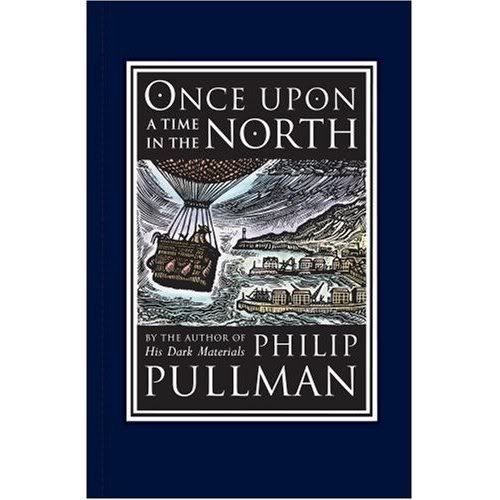
Once Upon a Time in the North- Philip Pullman


Once Upon a Time in the North- Philip Pullman

Astute readers will infer from the title of this blog that I am at least passingly familiar with the world of Philip Pullman's His Dark Materials. (The first person to correctly identify the reference in the comments wins a prize.) Passingly familiar is, however, a massive understatement. HDM is the series that revitalized my love of children's literature as an adult. It proved to me that the stories could be morally complex and ambiguous, while at the same time remaining true to notions of bravery, heroism, and sacrifice for the greater good. It also proved that stories for children could contain powerful ideas that maybe aren't so easily digested. These books made you THINK! I still remember finishing The Subtle Knife around 9:30 at night, and rushing out to my local bookstore to purchase The Amber Spyglass before it closed. Despite the disappointing (to me at least) movie, I remain a fan.

OUATITN is the second slim volume Pullman has written describing the exploits of characters from the original trilogy following Lyra's Oxford. OUATITN details the exploits of a young Lee Scoresby and his initial encounters with an extraordinary panzerbjorn named Iorek Byrnison. Apparently, before Pullman is finished, there will be a third mini-story featuring the adventures of Will. Perhaps Pullman will then turn his attentions to the long-rumored follow up trilogy to HDM.

The story begins with Lee and his beloved hare deamon Hester in dire straits as his newly-acquired balloon is losing altitude near the arctic island of Novy Odense. Lee makes quite an impression on the local populace (after a barely controlled crash landing.) Being the iconoclastic, fair-minded individual that he is, it doesn't take Lee long to run afoul of the local powers that be.

It seems Novy Odense, despite the best efforts of local government, is controlled by the machinations of the Larsen Manganese mining company. More interested in turning a profit than conducting fair business, the company is currently preventing a captain from loading his rightful cargo and departing the Port before paying extra taxes and fees. The captain cannot afford those prices, and risks losing his entire cargo and livelihood. Anyone who remembers Lee's selfless sacrifice from HDM knows that Lee Scoresby will not abide in the strong lording over the weak.

Lee and Iorek Byrnison team up to help the captain free his cargo. Along the way they run into a crooked mayoral candidate, a terrifyingly merciless gunfighter, and other assorted ne'erdowells. Will their efforts be enough? Can even the might of a panzerbjorn stand against the awesomeness of an early tank prototype? I won't give away the answer, but if you know anything about Iorek, then you can probably guess....

The story is brief, less than 100 pages, but the pace is brisk, and the reader is left wanting more. The volume is beautifully crafted, illustrated with engravings from John Lawrence. It is also interspersed with ephemera from the HDM such as pages from The Elements of Aerial Navigation, a how-to ballooning manual Lee uses, the rules for the board game Peril of the Pole (the actual game itself is also included in the book), and a newspaper article describing incidents from the book from a different perspective from that of the main characters. There are even hints at Lyra's future scattered toward the back, so make sure you read everything!

Overall, I highly recommend it, although there are some scary scenes in the book where violence is frankly discussed. Also, being British, Pullman is more casual toward some of the milder swear words that we are unused to in our American fiction for children. None are used gratuitously, and all fit in with the nature of the characters. In particular, I'm referring to the B word, the D word, the H word, and the A word. If you enjoyed the original HDM trilogy, then you'll love Once UPon a Time in the North.

Friday, July 11, 2008

Ranger's Apprentice: Ruins of Gorlann

For my inaugural post I'd like to address a phenomenon in children's literature that has emerged in the wake of the phenomenal publishing success surrounding the trials and tribulations of a certain young wizard: the dearth of inferior or downright derivative fantasy series that have sprung up in its wake like so many night crawlers wriggling helplessly on the sidewalk after a summer downpour. Publishing, like any other big business, loves proven winners. When Harry Potter sold through the roof, then the green light was given to dozens of lesser series (I'm looking at you Inheritance Trilogy, aka "The Lord of the Star Wars"), while at the same time pushing authors with legitimate vision and innovative ideas if their books did not have sequel potential.

The "Ranger's Apprentice" series by John Flanagan is a pleasant exception to this dismaying trend. Thus far, the first three volumes exist in paperback, and the fourth is still only available as a hardcover. Flanagan eventually intends to publish seven books in all. All seven are currently available in his native Australia. Visit the official website here.

Book One, The Ruins of Gorlan, tells the story of the orphan boy Will and other orphans in Redmont Fief, within the kingdom of Arulen. As they approach the "Choosing Day," they will be selected for the job that they will serve in for the rest of their lives. As can be expected from the title of the series, Will is selected for Ranger training. He had had his heart set on Battle School, but he soon learns to embrace his calling. Under the tutelage of the gruff and mysterious Halt, will begins to learn the way of the Ranger: unseen movement, tracking, archery, cartography, and horsemanship.

The Rangers serve as the eyes and ears of the kingdom of Arulen, especially when the evil Lord Morgarath, who had been banished from the kingdom after leading a failed rebellion fifteen years before. Oftentimes, the first books in a series are overburdened with exposition and origin stories, but The Ruins of Gorlan has plenty of action as well. Interspersed between Will's training chapters are the stories of several of the other orphans and their endeavors, as well as the schemes and machinations of Morgarath and his armies of Wargals (an Ork-like creature that resembles a cross between a gorilla and a bear), and the particularly horrifying creatures the Kalkara.

As the plot advances, the Kalkara are loosed on the kingdom, and it is up to Halt and Will to stop them before too much carnage is unleashed. The Ruins of Gorlan is highly recommended for fans of fantasy, and adventure series along the lines of Lloyd Alexander, Ursula K. Leguin, or C.S. Lewis.